
Why India Is Winning The AI Race Nobody Is Watching
1.4 billion people. A 5,000-year-old philosophy of mind. And a sovereign AI bet the West is not paying attention to.

I want to tell you something that did not make the mainstream AI conversation this week. Or last week. Or the week before.
India is the second-largest ChatGPT user base on earth. One in eight weekly users globally. Eighty per cent of Indian professionals use AI tools at work — against fifty per cent in the United States. On LinkedIn, Indian profiles show AI skill penetration at three times the global average, ahead of America and Germany.
The country is not waiting for permission to lead. It never was.
I recorded a conversation recently with Tushar Kansal — a venture capitalist who steers a network of more than 1,700 international investors and has spent a decade at the intersection of capital, technology, and human ambition. He does not trade in comfortable narratives.
He said something early in our conversation that I have not stopped thinking about.
“The world is having a conversation about AI without India in the room.”
Not a grievance. A statement of fact. And a warning for every leader still equating innovation with postcode.
What India is actually building
The India AI Mission is funding Sarvam AI — a home-grown language model built not for English, but for the more than 700 languages spoken across the country. It is being embedded into the India Stack — the national biometric identity and real-time payments network that already makes India the global leader in digital transactions.
Startups like Fuzzle are deploying predictive AI for micro-weather forecasting across 140 million small farm holdings. Healthcare companies like Niramai are using thermal imaging for non-invasive cancer screening at a fraction of the Western equivalent cost.
This is not pilot project territory. This is deployment at civilisational scale.
The philosophy underneath it
The deepest part of my conversation with Tushar had nothing to do with summits or statistics.
He spoke about what he calls Self-Engineering. The conviction that the human inside the founder matters more than the technology the founder deploys.
In a world where every founder holds the same tools, the differentiator is not the tool. It is the consciousness behind the hand that holds it and the intent.
He invoked Osho — the Indian mystic — to draw a line between two orientations.
A hammer is useful. A machine is useful. Asking how to remain useful is the language of something built to serve.
“AI can give you the right answer,” Tushar told me. “But it cannot give you the right intention. Intention is the invisible architecture behind everything you build.”
Silicon Valley tends to arrive at this conclusion reluctantly, as a concession. India has been building from it as a foundation.
What this means for you this week
Three things worth sitting with:
Read the scale correctly. If your strategy does not account for India’s adoption pace, you are modelling the future around the wrong map.
Apply the Jugaad test. Before you approve the expensive build, ask whether a smarter, lighter method achieves the same result. Constraint is often the origin of precision.
Protect your intention. Every tool you adopt creates a relationship with the company that built it. What you build on top of it — the trust, the creativity, the human judgment — remains yours entirely.
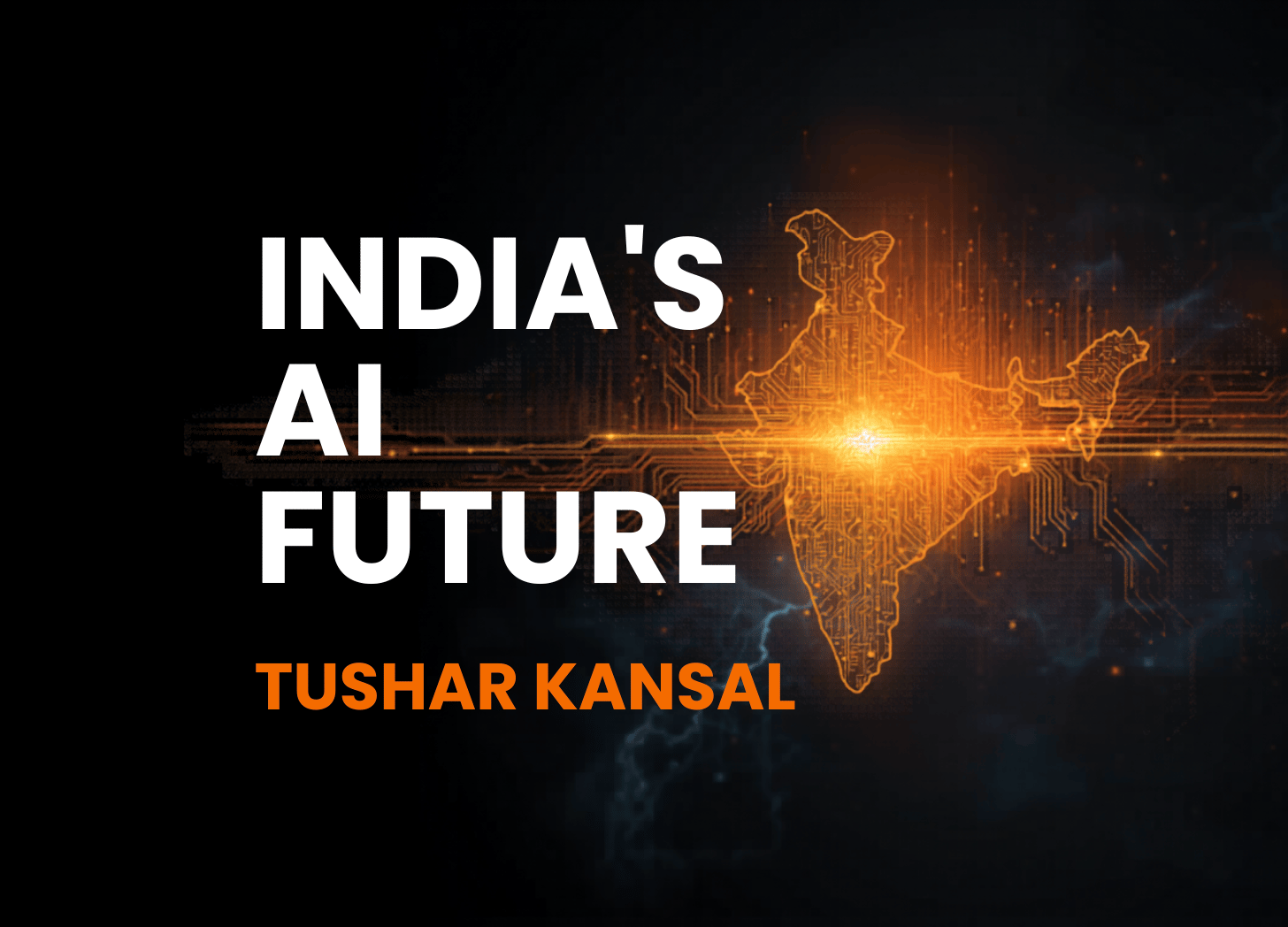
The full piece is on my website. The full conversation with Tushar is live now on Influential Visions.
If someone in your network is navigating the AI shift — send this to them. It will land at the right moment.
And if you want this kind of thinking every Monday, without the noise — that is exactly what Monday Influencer® is built for.
Nat Schooler is co-founder of Monday Influencer® and host of Influential Visions. He has recorded 500-plus expert conversations over a decade and writes here weekly on leadership, AI, and the durable human.